Are Gut Bacteria Supplements Good? The Strains That Are Studied

Quick Answer: Are Gut Bacteria Supplements Good?
Some are, and the difference is the strain rather than the brand. A short list of named strains — among them Lacticaseibacillus rhamnosus GG, Saccharomyces boulardii CNCM I-745 and Bifidobacterium longum subsp. infantis 35624 — has been through repeated human trials, while most products on the shelf use organisms with little or no published human data at all. If a label prints a genus and a species but no strain code, the research you read about elsewhere does not automatically apply to what is inside that bottle.
- Strain codes carry the evidence: "GG" or "CNCM I-745" identifies one organism; "Lactobacillus" names a group of hundreds.
- Doses in published trials generally sit between roughly one billion and a few tens of billions of CFU per day, depending entirely on the strain.
- Most strains are transient. They pass through rather than settle in, so effects usually fade when you stop taking them.
A strain is not the same thing as a species
Every organism on a gut supplement label has a three-part identity, and almost nobody reads past the first two. Take Lacticaseibacillus rhamnosus GG. The first word is the genus, a broad family grouping. The second is the species. The third — GG — is the strain designation, the code that points at one specific, deposited, catalogued organism held in a culture collection.
Think of it as a surname, a first name and a fingerprint. Two people can share a surname and a first name and still be entirely different individuals. Two strains of the same species can differ in which sugars they ferment, which compounds they produce, whether they survive stomach acid, whether they stick to the gut lining at all, and what a trial found when it tested them. This is the single most useful thing to understand about the category, and it is the reason a blanket answer to "do probiotics work" is meaningless.
The naming got harder in 2020, when the sprawling genus Lactobacillus was formally split into twenty-five genera. L. rhamnosus became Lacticaseibacillus rhamnosus; L. plantarum became Lactiplantibacillus plantarum; L. reuteri became Limosilactobacillus reuteri. The organisms did not change; the taxonomy caught up with the genetics. Helpfully, all of them still abbreviate to "L.", so a label reading "L. plantarum" tells you nothing about whether the manufacturer has updated anything. The strain code is the only part of the name that stayed stable through the reshuffle, which is a good argument for treating it as the thing you actually shop on.
The strains with the most human data behind them
A handful of organisms have been studied far more than the rest, largely because they were deposited early, patented, and then licensed to manufacturers who funded trials. That history is worth knowing: the best-evidenced strains are not necessarily the best organisms in nature, they are the ones somebody paid to investigate.
Lacticaseibacillus rhamnosus GG is the most heavily published probiotic strain in existence, with a research record stretching back to the 1980s across a wide range of endpoints and populations. The volume of studies is genuinely large; the quality is uneven, and pooled analyses of that literature have repeatedly landed on modest effects with wide confidence intervals.
Saccharomyces boulardii CNCM I-745 is not a bacterium at all — it is a yeast, which gives it one distinctive practical property: antibacterial drugs do not touch it. That is why it turns up so often in research conducted alongside antibiotic courses, where bacterial strains would simply be killed off.
Bifidobacterium longum subsp. infantis 35624 was studied in adults using standardised symptom questionnaires rather than laboratory markers, which is unusual in this field and makes its results easier for a general reader to interpret.
Bifidobacterium lactis HN019 and BB-12 have been examined mainly for whole-gut transit time and stool regularity — outcomes that can be measured objectively rather than reported on a scale, which is a point in their favour.
There is also a high-dose multi-strain formulation used in specialist gastroenterology settings under medical supervision. It is worth knowing it exists, and worth understanding that it is a different category from a shelf supplement: different doses, different oversight, different purpose. Nothing you buy over the counter is that.
How the studied strains compare
| Strain | What trials mostly measured | Typical daily amount in studies | Weight of human evidence |
|---|---|---|---|
| L. rhamnosus GG | Stool frequency and consistency; general gastrointestinal comfort | Around 1–20 billion CFU | Large volume, mixed quality |
| S. boulardii CNCM I-745 | Gastrointestinal outcomes during and after antibiotic courses | Around 250–500 mg of the yeast preparation | Substantial |
| B. longum subsp. infantis 35624 | Self-reported symptom scores on validated questionnaires | Around 1 billion CFU | Moderate |
| B. lactis HN019 / BB-12 | Whole-gut transit time; bowel regularity | Around 1–20 billion CFU | Moderate |
| L. reuteri DSM 17938 | Infant studies; adult data thinner | Around 0.1–1 billion CFU | Narrow but real |
| Unnamed blend, no strain codes | Nothing you can check | Unknowable from the label | None you can verify |
That last row is not a joke. A large share of the category, including many products marketed as the best gut bacteria supplement in their category, lists genus and species only. When that happens the published research becomes decoration: it describes organisms that may or may not be the ones in the capsule.
Reading labels the same way across your shelf
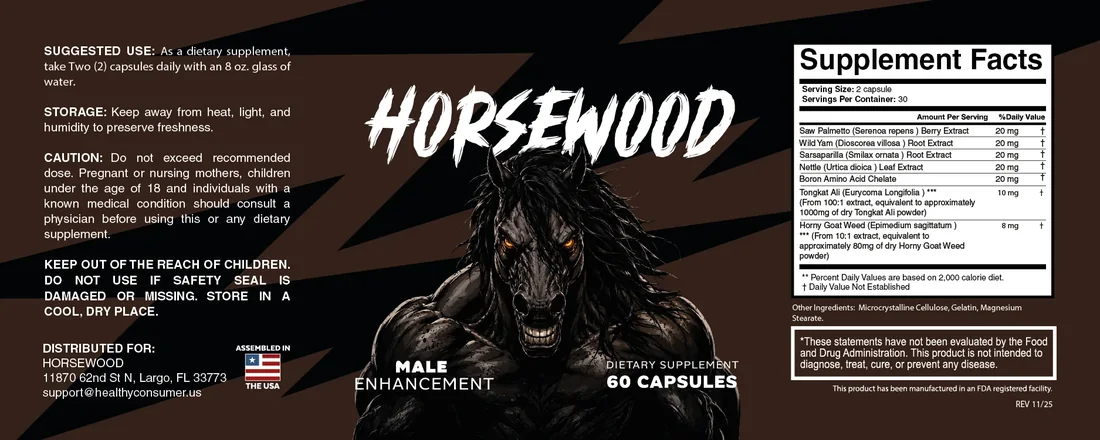
The discipline that separates a studied strain from a decorative one is the same discipline that separates a properly dosed botanical formula from a familiar-sounding blend. If you are working through the men's aisle with that checklist in hand, the Horsewood formula and its pack options are laid out in full.
See the Horsewood pack optionsWhat a CFU count does and does not tell you
CFU stands for colony forming units: a count of organisms alive enough to reproduce on a culture plate. It is a measure of quantity, not of relevance, and the supplement aisle has spent a decade turning it into a number arms race.
Three things matter more than the headline figure. First, whether the count matches the dose used in trials for that specific strain. A strain studied at one billion CFU does not become better at fifty billion; it becomes more expensive, and possibly harder on your digestion in the first week. Second, when the count was measured. "At time of manufacture" is a promise about a factory; "through end of shelf life" is a promise about the product in your hand, and only one of those is useful. Third, how it was stored on the way to you. Heat and moisture kill live cultures, and a bottle that spent a summer in a warehouse has an unknowable count regardless of what the carton says.
Delivery claims deserve the same scepticism. Enteric coatings, capsule-in-capsule designs and freeze-drying are all real technologies, and the claim that a strain "survives stomach acid" needs evidence for that strain in that format — not a general statement about the technology.
Where the marketing outruns the evidence
Three phrases do most of the heavy lifting in this category, and all three are weaker than they sound.
"Clinically studied strains" often means that one strain in a ten-strain blend has a study behind it, frequently at a dose the finished product does not contain. "Fifty billion CFU" is a quantity claim wearing the costume of a quality claim. This kind of label language survives because of what over-the-counter really means for a supplement: no regulator checks the claim before the bottle ships. And "restores your microbiome" describes something no supplement has been shown to do: your resident microbial community is shaped by years of diet, medication, genetics and environment, and a capsule of transient organisms does not rewrite it.
A strain code on a label is not proof that a product works. It is proof that you can go and check. Almost nothing else on a gut supplement label gives you that.
The same logic applies when you compare the best gut health probiotic supplement lists that circulate online. Ranked lists are usually built from brand prominence and price, not from strain-level evidence, and two products with identical species lists can be entirely different purchases.
How to read a gut bacteria supplement label in ninety seconds
Run this in order and you will filter out most of the aisle before you have finished the panel.
- Find the strain codes. No codes, no verifiable research. Put it down.
- Check the CFU wording. You want a guarantee through the end of shelf life, per serving, and ideally per strain rather than one total for the blend.
- Match the dose to the study. Search the strain code and see what amount the trials used. If the product is far below it, the research does not describe this product.
- Count the strains and ask why. Twelve strains is a marketing decision more often than a formulation one, and it usually means each is present in a small fraction of a studied dose.
- Read the storage line and the carrier. Milk-derived carriers, inulin and chicory root fibre all matter to some people, and they are printed in the "other ingredients" line nobody reads.
Applied consistently, this is also how you compare the best gut health supplement brands against each other without relying on packaging. It is unglamorous work, and it is the only part of the process that reliably tells you something true.

What gut bacteria supplements cannot do
This is the section most pages in this category leave out, so here it is plainly.
They do not replace dietary fibre and food variety. The organisms already living in you respond far more to what you eat every day than to what you swallow in a capsule, and the research on fermentable fibre is considerably stronger than the research on most supplemental strains. They do not permanently change your microbial makeup: colonisation by supplemented strains is generally transient, and when the supplement stops, so does the detectable presence.
They are not appropriate for everyone. Live organisms behave differently in a compromised body, and people who are immunocompromised, critically ill, fitted with a central venous catheter or recovering from major abdominal surgery should take medical advice before starting one. Individual response also varies enormously — plenty of well-run trials find no meaningful separation from placebo, and "it did nothing for me" is a perfectly normal outcome that the category rarely acknowledges.
Finally, these are foods, not medicines. Nothing in this category is intended to diagnose, treat, cure or prevent any disease, and any page telling you otherwise is telling you something it is not allowed to say.
Where this sits next to a men's botanical formula
Gut bacteria supplements and botanical men's formulas are different products aimed at different things, and it is worth being clear that Horsewood is the second kind — a plant-extract formula built around traditional botanicals rather than live cultures. What the two categories share is the label problem. In both, the difference between a product with research behind it and a product with familiar words on the front comes down to identifiers and amounts: strain codes and CFU counts in one, extract ratios and per-ingredient milligrams in the other.
If you want to see how that second checklist works, our guide to reading a supplement label past the proprietary blend covers the same discipline applied to botanicals. The habit transfers cleanly, and once you have it, most of the aisle sorts itself. Two companion pieces finish the job: what gut supplement trials actually measure, and what the first two weeks on a gut supplement really feel like.

If you have finished checking and want the details
Full ingredient breakdown, per-serving amounts and the current pack options, with nothing hidden behind a blend name.
View Horsewood pack optionsCommon questions
Are gut bacteria supplements good for everyone?
No. Most healthy adults tolerate the common strains well, but people who are immunocompromised, seriously ill, fitted with a central venous catheter or recovering from major abdominal surgery should speak to a clinician before starting one. Live organisms behave differently in a compromised body than in a healthy one.
What does the strain code on a probiotic label mean?
It identifies the exact organism. A name like Lacticaseibacillus rhamnosus GG has three parts: genus, species and strain. The strain code is the part research is attached to, because two strains of the same species can behave completely differently in the body.
Is a higher CFU count better?
Not automatically. CFU counts the live organisms in a serving, and the number that matters is the one used in the published trials for that strain. Some strains were studied at around one billion CFU daily, so a product advertising a hundred billion is not simply a hundred times better.
Do gut bacteria supplements need refrigeration?
It depends on the strain and how it was processed. Freeze dried and encapsulated strains are often shelf stable, while others lose viability at room temperature. Follow the storage line on the carton, and prefer products that guarantee the CFU count through the end of shelf life rather than at the time of manufacture.
References
- National Institutes of Health, Office of Dietary Supplements. Probiotics: fact sheet for health professionals. ods.od.nih.gov
- National Center for Complementary and Integrative Health. Probiotics: what you need to know. nccih.nih.gov
- Harvard T.H. Chan School of Public Health, The Nutrition Source. The microbiome. nutritionsource.hsph.harvard.edu
- McFarland LV, Evans CT, Goldstein EJC. Strain-specificity and disease-specificity of probiotic efficacy: a systematic review and meta-analysis. Frontiers in Medicine, 2018. PubMed 29868585
- Mayo Clinic. Probiotics and prebiotics: consumer health guidance. mayoclinic.org