Testosterone Booster Pills, Powders and Gummies Compared

Quick Answer: What Is Testosterone Booster Pills?
Testosterone booster pills are dietary supplements in capsule or tablet form that combine minerals, vitamins and plant extracts sold on the claim that they support the body's own hormone production. They contain no testosterone, because testosterone is a prescription-only substance in the United States. Powders and gummies use the same class of ingredients in a different container, and the format mainly changes how many milligrams fit into one serving rather than how well those milligrams work.
- Capsules and tablets hold the most active material per serving with the fewest passengers along for the ride.
- Powders are the only format with room for multi-gram ingredients, and the only one that has to be flavoured.
- Gummies buy palatability with space: sugar and a gelling agent occupy most of the piece.
What testosterone booster pills are, in plain terms
The question as people type it — what is testosterone booster pills — deserves a literal answer before any comparison of formats becomes useful. A testosterone booster pill is a dietary supplement pressed into a tablet or filled into a capsule. It is regulated as a food, not as a medicine. It does not contain the hormone itself, and no product sold on an open shelf legally can.
What is inside is usually drawn from a fairly predictable list. Minerals with a documented role in normal hormone production come first: zinc, magnesium, and increasingly boron. Vitamin D appears in most formulas because low status is common and easy to correct. Then come the botanicals, which is where the marketing lives: ashwagandha root extract, fenugreek seed, tongkat ali, maca, tribulus, horny goat weed, and a rotating cast of others. Some of these have been studied in humans at defined doses. Several have almost nothing behind them beyond long traditional use and a memorable name.
The claims a label may carry are limited to structure and function language, which is why every panel reads the same way. "Supports healthy testosterone levels" is permitted. "Treats low testosterone" is not, and any product using that phrasing has stopped being a supplement in the eyes of the law. Understanding that boundary explains most of the odd, hedged wording you see across the category.
What actually changes when the format changes
Three things vary between a capsule, a scoop and a gummy: how much active material fits into a serving, what has to ride along with it, and whether you keep taking it. That is essentially the whole comparison.
Absorption is the variable marketing leads with and the one that changes least. Minerals and standardised plant extracts have to dissolve and cross the intestinal wall no matter what carried them into your stomach. Chewing does not create a shortcut for a 300 mg root extract, and the sublingual claims attached to some gummies and sprays are not supported for molecules of that size. The one genuine format effect worth knowing is that vitamin D is fat-soluble and is absorbed better in an oil-based softgel or alongside a meal containing fat.
Dose room, by contrast, changes enormously. A standard size 00 capsule holds roughly half a gram to just under a gram of powder depending on how dense that powder is, which is why multi-ingredient formulas ask you to take two, three or four capsules rather than one. A gummy typically weighs a few grams, and the great majority of that mass is sugar or a sugar alcohol, a gelling agent, acid, colour and flavour. A powder scoop can carry five to ten grams without any difficulty at all.
Capsules and tablets: the workhorse format
Most formulas in this category are capsules for unglamorous reasons. There is no flavour system to build, so the manufacturer is not forced to choose between a tolerable taste and a meaningful dose. The shell protects light-sensitive and moisture-sensitive extracts. Per-serving accuracy is fixed at the filling machine rather than left to a scoop. And the cost per milligram of active material is generally the lowest of the three.
The trade-offs are real but modest. Multi-capsule servings annoy people, and anyone who dislikes swallowing capsules will quietly stop. Tablets can be compressed to hold more material than a capsule, but they need binders and disintegrants to hold together and then fall apart on schedule, and a badly made tablet can pass through largely intact. Capsule shells are worth a glance too: gelatin shells are animal-derived, while HPMC shells are plant-based, and only one of those suits a vegetarian buyer.
There is also a specific label trick that lives in this format. A panel reading "Proprietary Blend 1,500 mg" across a four-capsule serving tells you the total weight of a mixture and nothing about how it is divided. The serving size line at the top of the panel is the first thing to read, because every number underneath it describes the whole serving rather than a single capsule.
Comparing formats is easier when the numbers are printed
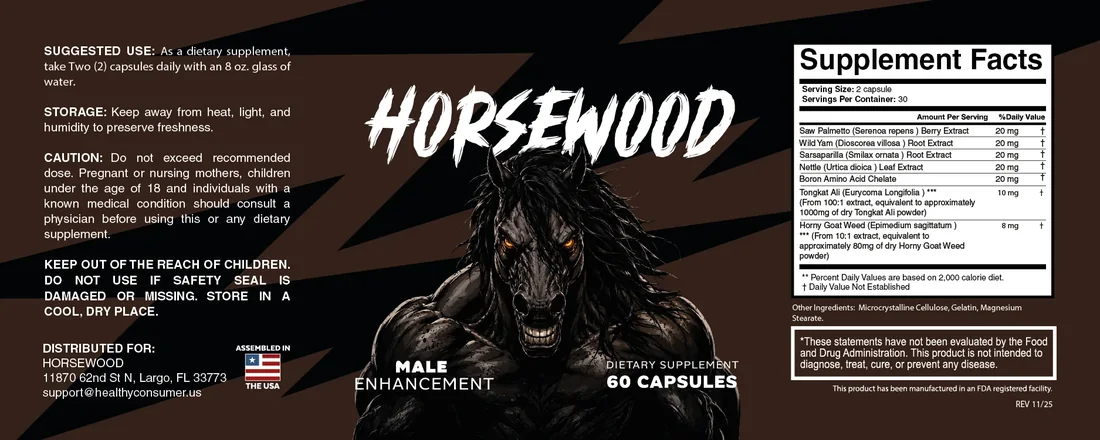
Format only matters once you can see per-ingredient amounts. If you are working out where to buy a testosterone booster that prints them, the Horsewood formula, serving size and pack options are laid out in full.
See the Horsewood pack optionsPowders: dose room you cannot get any other way
Some ingredients cannot be squeezed into a pill at the amounts used in research, and that is the honest case for a powder. Creatine monohydrate is studied at several grams a day. D-aspartic acid trials have used roughly three grams. Certain amino acids are the same story. A two-capsule serving physically cannot contain five grams of anything, so a product built around those ingredients either arrives as a powder or arrives underdosed.
The cost of that dose room is taste. Once you dissolve gram quantities of minerals and bitter plant extracts in water, you need flavour, sweetener, an acid and usually an anti-caking agent to make the result drinkable, and those additions are inert but not invisible. Scoop accuracy is looser than a capsule fill, particularly when powder settles in transit. And the format demands a habit: a capsule travels in a pocket, while a powder needs water, a shaker and a moment you may not always have.
Powders also make one thing harder to spot. A capsule label forces a manufacturer to be specific about a small number of milligrams. A large scoop can carry a big total weight while a single conspicuous ingredient does most of the work and the rest sit at token amounts, which looks generous on the tub and thin on the panel.
Gummies: the format that pays for taste in milligrams
Gummies solved a genuine problem. People who will not swallow capsules were simply not taking anything, and a supplement you actually take beats a better one sitting in a cupboard. That is not a small point, and it is the strongest argument the format has.
The weakness is structural. The base of a gummy is sugar or a sugar alcohol plus pectin or gelatin, and that base has to make up most of the piece or it will not set. Active ingredients compete for the space that remains, which usually caps them in the low hundreds of milligrams per gummy. Manufacturers respond by making the serving two or three gummies, which multiplies the sugar along with the actives. Heat is the other constraint: gummies are made and stored warm relative to capsules, and several botanical extracts are not fond of that. Bitter ingredients such as tongkat ali are also very hard to mask at a meaningful dose, so they tend to be quietly reduced or dropped from gummy versions of the same brand's formula.
Where gummies genuinely work is single-nutrient, low-dose, palatable products. Vitamin D is a good fit. A modest zinc dose is a reasonable fit. A ten-ingredient hormone support formula at studied amounts is not, and no amount of packaging changes that arithmetic.
How the three formats compare on the things that matter
| Format | Typical serving | Room for actives | What rides along | Relative cost per milligram | Ease of checking the label |
|---|---|---|---|---|---|
| Capsules | 2–4 capsules daily | Roughly 1–3 g per serving | Shell, flow agent, sometimes rice flour | Lowest | Straightforward |
| Tablets | 1–3 tablets daily | Similar to capsules, sometimes more | Binders, disintegrants, coating | Low | Straightforward |
| Powder | 1 scoop in water | Several grams, the only format that allows it | Flavour, sweetener, acid, anti-caking agent | Low to moderate | Watch the scoop size |
| Gummies | 2–3 gummies daily | Low hundreds of milligrams | Sugar or sugar alcohol, pectin or gelatin, colour | Highest | Check sugar and per-gummy amounts |
| Softgels | 1–2 softgels daily | Small, but ideal for oil-soluble nutrients | Gelatin shell, carrier oil | Moderate | Straightforward |
Read that table sideways rather than downwards. No row is the winner. A powder wins if the formula needs grams; a softgel wins for vitamin D; a capsule wins for almost everything else in a multi-ingredient blend; a gummy wins only when the alternative is that you take nothing at all.
What choosing a format cannot do
This section exists because the rest of the internet skips it. Format is genuinely the last variable that matters, and it cannot rescue any of the ones that come before it.
It cannot make a weakly evidenced ingredient work. Tribulus terrestris has been examined repeatedly in men and has generally failed to raise testosterone, and putting it in a nicer container does not alter that record. It cannot correct a dose: an extract present at a fraction of the amount used in published trials is underdosed in a capsule, a scoop and a gummy alike. It cannot tell you whether your own testosterone is actually low, which is a question only a blood test taken in the morning, ideally twice, can begin to answer. And none of these products do what prescription hormone therapy does. They are not the same category of intervention, and the difference is one of kind rather than degree.
It is also worth being blunt about the evidence base as a whole. Most trials in this space are small, run for weeks rather than months, and measure blood markers rather than how anyone felt. Where results exist they are often modest and inconsistent between studies. That does not make the ingredients worthless, but it does mean confident promises about any of them are running well ahead of what has been demonstrated.
A format is a container, not an ingredient. If the milligrams inside it are wrong, no container is going to fix that.
Choosing a format without overthinking it
Four questions settle it, in this order.
- Does the formula contain anything measured in grams? If yes, buy the powder. If no, the powder is only costing you flavouring.
- Will you take it every day? Adherence outranks every technical argument here. Someone who reliably chews a gummy is ahead of someone who abandons capsules in week two.
- Does the panel print per-ingredient amounts? A blend total is a refusal to answer. This single check filters more of the aisle than any comparison of delivery systems.
- Is there third-party testing? Certification marks such as NSF or USP mean an outside laboratory confirmed that the contents match the label. They are not common in this category, and their absence is normal rather than damning, but their presence is meaningful.
Run those four questions across any shortlist of the best testosterone booster you can buy and most of the shortlist eliminates itself before you have compared a single price. That is the point of the exercise. Format is a preference; dose and disclosure are facts, and facts are the part worth shopping on.
Where a botanical capsule formula sits in this comparison
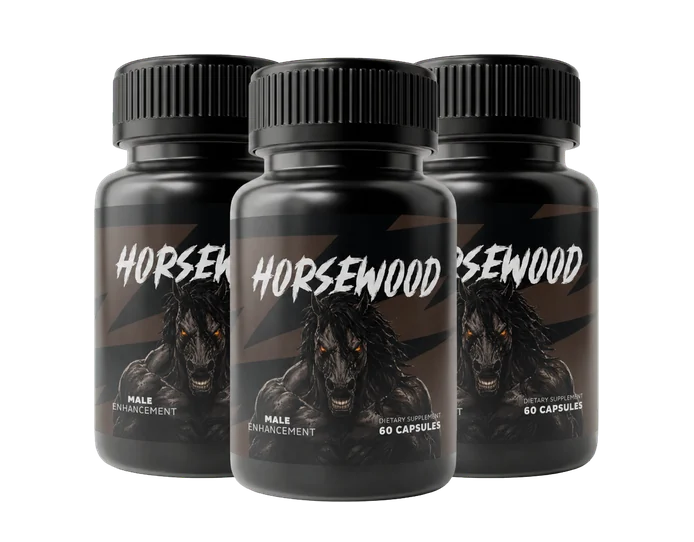
If the search that brought you here was what is testosterone booster pills, this is what the answer looks like in practice. Horsewood is a capsule formula built around plant extracts rather than a powder or a gummy, which places it in the first row of the table above. That is a deliberate trade-off, not a claim of superiority. Capsules mean no flavour system competing for space, no sugar base, and per-ingredient amounts printed on the panel where you can check them against the doses used in research — the same discipline set out in how to read a supplement label past a proprietary blend. We put the two formats side by side in capsules versus testosterone gummies.
It also means the same limits apply. A capsule cannot deliver a multi-gram ingredient, and a botanical formula in any container is a support product with a modest and uneven evidence base behind it, not a treatment for anything. If you want the next layer of this checklist, our companion piece on what over-the-counter really means for testosterone boosters covers the regulatory side of the same question: what these products are allowed to be, and what the shelf they sit on does and does not guarantee.
If you have settled on capsules and want the details
Full ingredient list, per-serving amounts and the current pack options, with nothing hidden inside a blend total. This is also the page to check if you are comparing where to buy a testosterone booster with a printed panel.
View Horsewood pack optionsCommon questions
What are testosterone booster pills made of?
They are capsules or tablets containing minerals such as zinc, magnesium and boron, sometimes vitamin D, and standardised plant extracts such as ashwagandha, fenugreek or tongkat ali. They contain no testosterone, because testosterone is a prescription-only hormone in the United States.
Are testosterone booster gummies as effective as capsules?
Not usually, and the reason is arithmetic rather than absorption. A gummy is mostly sugar or sugar alcohol plus a gelling agent, which leaves only a few hundred milligrams of space for active ingredients. Capsules can hold several times that amount per serving, so most gummies sit below the doses used in published research.
How many capsules is a normal serving?
Two to four capsules a day is typical for a multi-ingredient formula, because one capsule rarely holds enough of several ingredients at once. Read the serving size line first, since the amounts printed on the panel describe the full serving and not a single capsule.
Do powders work faster than pills?
A powder dissolved in water may empty from the stomach slightly sooner than a capsule, but that difference is measured in minutes and does not change the outcome. Nutrient and botanical effects on hormone markers are studied over weeks, so a head start of half an hour is irrelevant.
References
- National Institutes of Health, Office of Dietary Supplements. Dietary supplements for exercise and athletic performance. ods.od.nih.gov
- National Institutes of Health, Office of Dietary Supplements. Zinc: fact sheet for health professionals. ods.od.nih.gov
- Mayo Clinic. Testosterone therapy: potential benefits and risks as you age. mayoclinic.org
- Neychev VK, Mitev VI. The aphrodisiac herb Tribulus terrestris does not influence the androgen production in young men. Journal of Ethnopharmacology, 2005. PubMed 15994038
- Harvard T.H. Chan School of Public Health, The Nutrition Source. Vitamin D. nutritionsource.hsph.harvard.edu